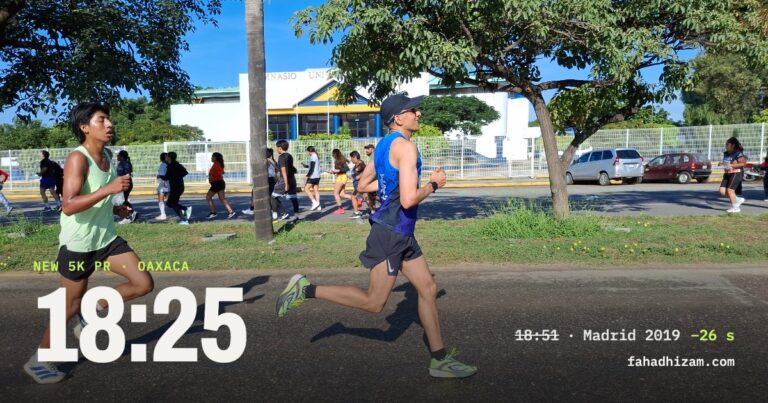

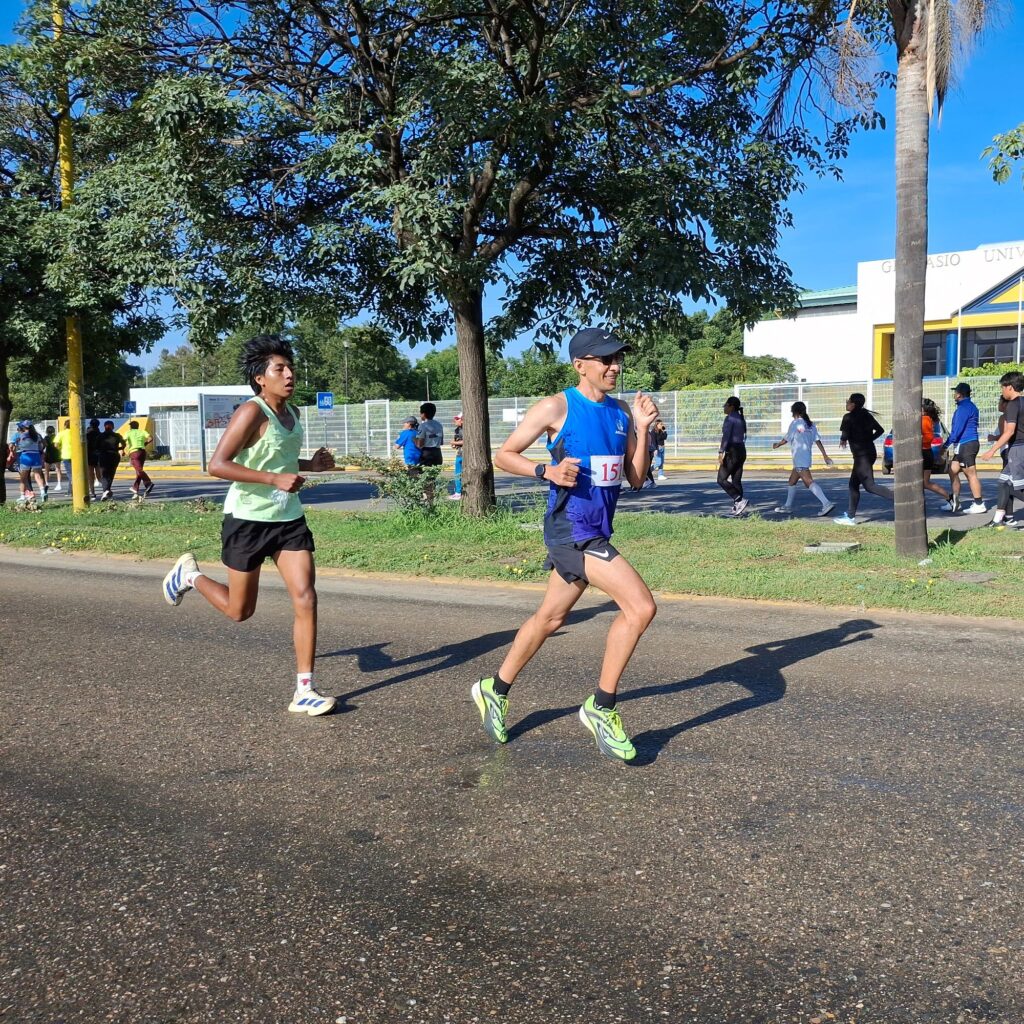
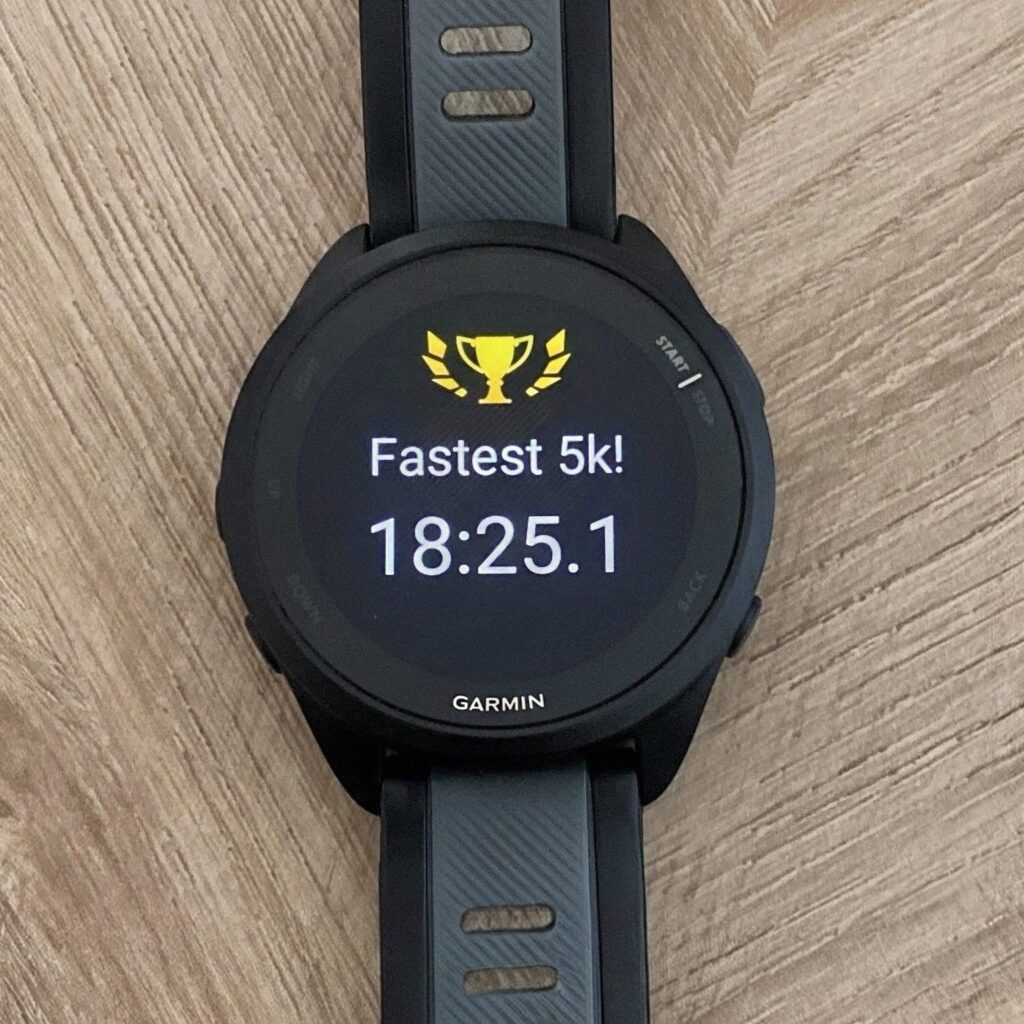
On September 20, 2026, Garmin recorded the fastest 5K I have run: 18:25, at an average pace of 3:41/km, during the XXX Carrera Atlética “Mtro. Nahúm Carreño Vásquez” in Oaxaca de Juárez.
I had gone into the race aiming for 18:20. I missed the target by 5 seconds and beat the 18:51 I ran in Madrid on November 10, 2019. That record had lasted almost 7 years.
A record that had lasted since Madrid
My previous 5K best came in Madrid in November 2019. I ran 18:51 there, at roughly 650 to 670 m above sea level.
Nahúm was run at around 1,550 m in Oaxaca. Garmin’s 18:25 was 26 seconds faster than the Madrid result. I used Enduraw to estimate how altitude, heat, elevation and wind affected the 18:25. Its calculation returned an adjusted equivalent of 17:40, close to 3:32 per kilometre. Altitude cost 7 s/km and the 20°C heat cost 3 s/km, while the route’s elevation profile helped by 1 s/km. Wind had no effect. The figure is a performance estimate.
3 years at Nahúm
I have run Nahúm 3 times, in 2023, 2024 and 2026, which allows a same-course comparison.
| Year | Nahúm 5K comparison | Running in previous 12 months |
|---|---|---|
| 2023 | 19:42 | 1,819 km |
| 2024 | 20:24 | 2,251 km |
| 2025 | Did not race | 1,017 km |
| 2026 | 18:26 | 3,393 km |
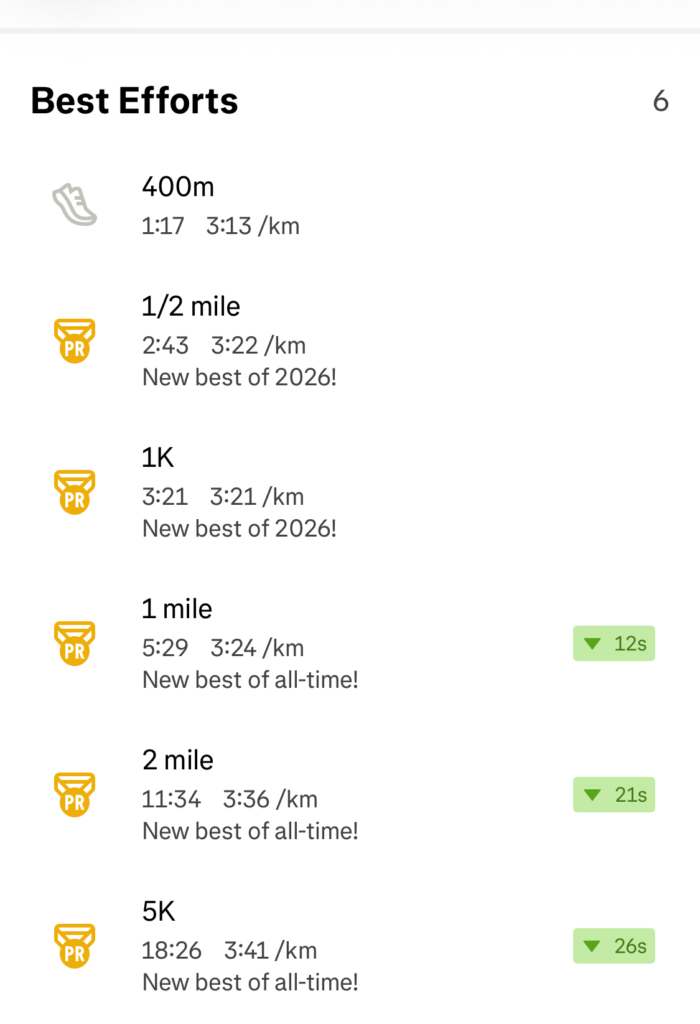
My 2023 and 2024 races are recorded in Strava, so the table uses Strava’s 5K Best Effort for all 3 years, including 18:26 for 2026. From 19:42 in 2023 to 18:26 in 2026, the improvement was 1 minute 16 seconds, or about 6.4%.
In the 12 months before the 2024 race, I ran 432 km more than before the 2023 race and finished 42 seconds slower, in 20:24. By 2026, annual volume had reached 3,393 km, 86% more than before the 2023 race and 51% more than before the 2024 race.
Almost 5 months without running
September 22, 2024 was my last road race before the injury period. A stress fracture in my left foot followed, and on January 11, 2025 I had carpal tunnel surgery on my left hand. Between the fracture, the operation and recovery, nearly 5 months passed without meaningful running.
I returned on a treadmill on February 26, 2025 and ran outside again on March 3. In June 2025 I joined J.M. Aquino Athletic Club and began training with coach Arnulfo Morales Luna. By mid-2026, I was handling more running than at any earlier point in this comparison.
56 days from the marathon to the 5K
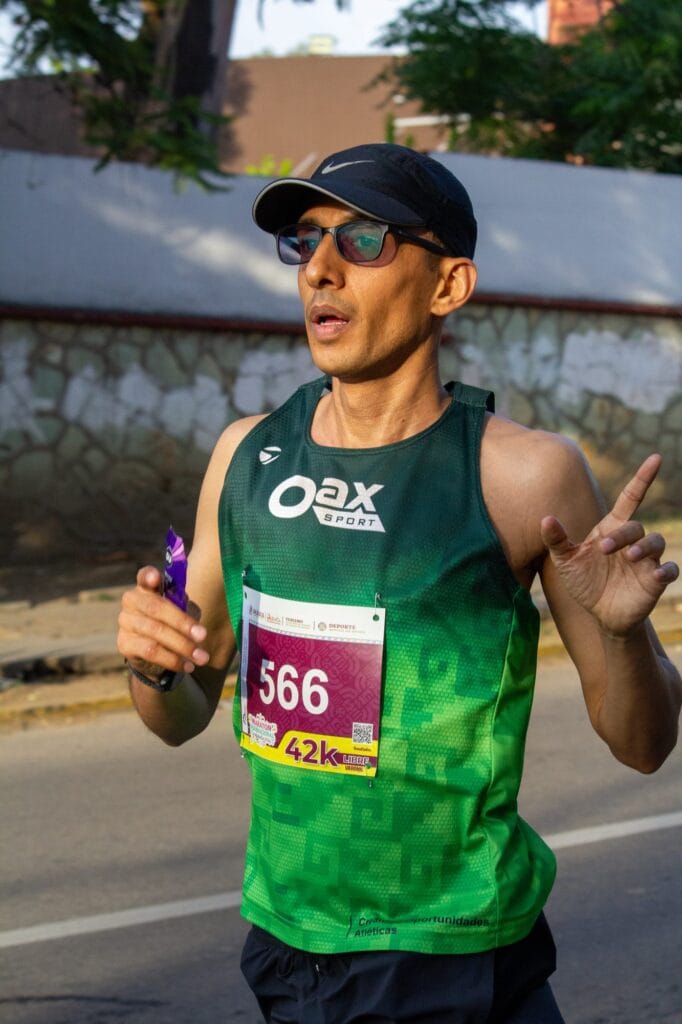
Nahúm came only 56 days after the Maratón Internacional Guelaguetza.
On July 26, my watch reached the standard marathon distance of 42.195 km in 3:14:08. My official Chronostart result over the race’s longer recorded distance was 3:15:48.26. I explain the distinction in my Maratón Guelaguetza 2026 race report.
The marathon had required months of high-volume running. After July 26, the sessions became shorter and faster while that endurance work was still recent.
On August 30, I ran 3000 m in 11:02. That works out to about 3:41/km, almost exactly the average pace Garmin later recorded for my 18:25 5K. For me, the 3000 m result was the clearest sign that the old 18:51 record was within reach.
What changed in the faster sessions
| Date | Session | Result |
|---|---|---|
| Aug 13 | 5 × 500 m | about 1:50 average |
| Aug 26 | 3 × 1000 m | 3:43, 3:42, 3:30 |
| Aug 28 | 8 × 400 m | about 1:22 average |
| Sep 4 | 10 × 400 m | about 1:22 average |
| Sep 11 | 12 × 400 m | about 1:22 average |
| Sep 12 | 8 × 500 m | about 1:45 average |
The 400 m average stayed near 1:22 while the session grew from 8 reps on August 28 to 12 on September 11. The 500 m session grew from 5 reps to 8, and the later reps were about 4.5% faster.
Strength stayed part of the week
I have trained strength with Ernesto González Carranza and Halcones CECAFID since 2022.
The amount changed as my running increased. In the 12 months before Nahúm 2024, I recorded 149 strength sessions while running 2,251 km. Before the 2026 race, the strength count was lower at 102 sessions while my running reached 3,393 km.
During the final 6 weeks before Nahúm, I ran 411 km, or about 68.5 km per week. I completed 12 strength sessions during the same period. None of those 12 sessions cost the next day’s run.
I cannot assign the 18:25 to one part of the program. The records show that strength stayed in the week while I handled substantially more running and more sustained fast work.
Race morning
Local reporting put participation at more than 4,500 runners. The event was organized around the Universidad Autónoma “Benito Juárez” de Oaxaca, and the route ran from the Facultad de Derecho y Ciencias Sociales toward Ciudad Universitaria.
The race started at 8:00 a.m. in about 20°C. My target was about 3:40/km. The route’s climbs and descents nearly cancelled out, with an average grade of 0.1%. Oaxaca’s altitude was familiar because I train here every week.
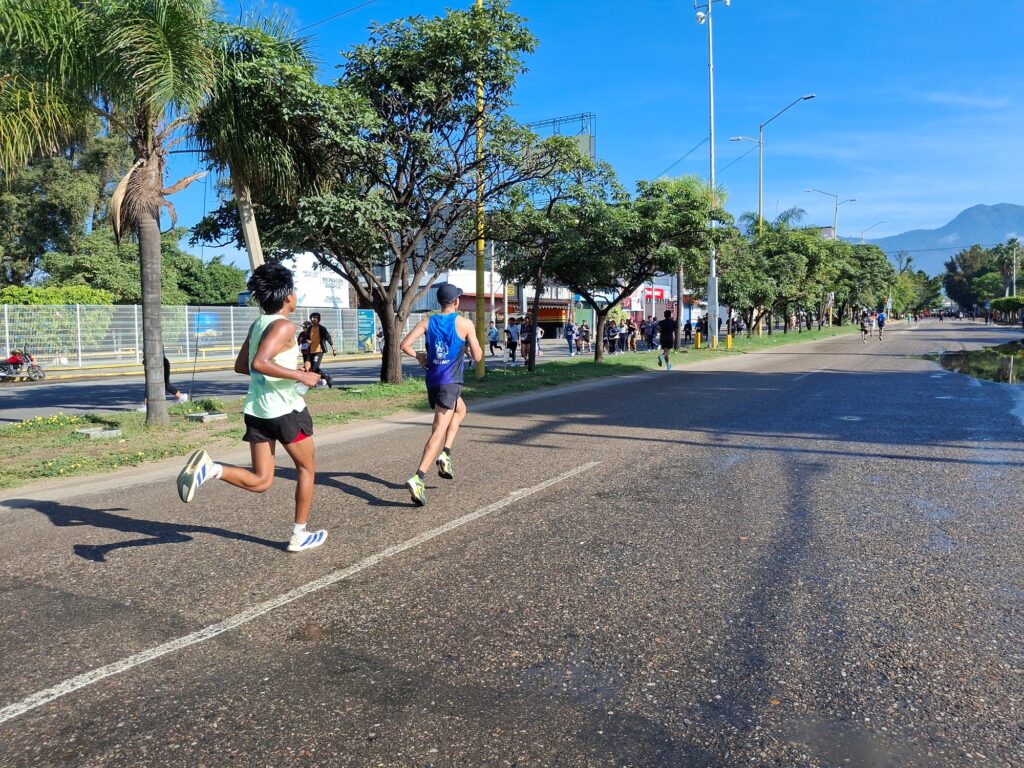
Rain had left standing water along the right side of the final street. That disturbed the closing section and forced me to adjust where I was running. I don’t know how many seconds it cost me.
Garmin recorded 18:25 for my fastest 5K segment. The Madrid record was gone.
A good morning for my teammates
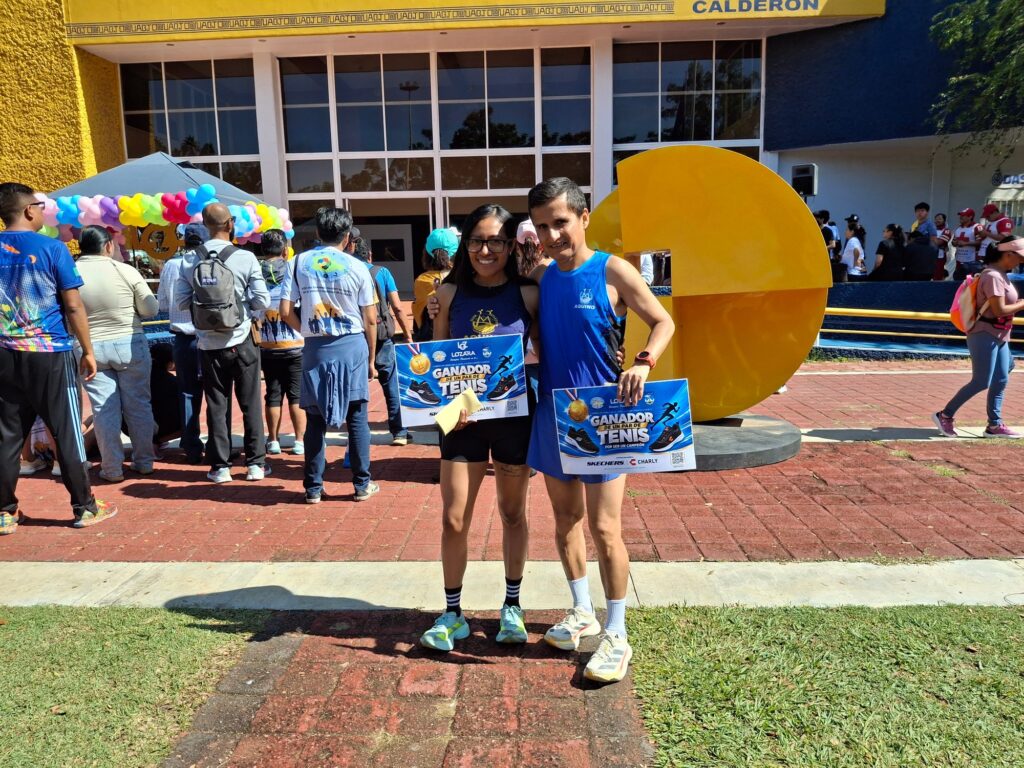
I also got to see 2 people I train with finish on the podium.
Leyda Guadalupe Cruz Hernández won the Libre Femenil category.
Dr. Arquímedes Jiménez Pavón finished 3rd in Máster Plus Varonil.
Congratulations to both of them.
Training with other athletes changes the experience of a race like this. You know what happened in many of the weeks before the start because you were there for part of it.
What I take from 18:25
My target remains 18:20.
After almost 7 years waiting to move past 18:51, the next 5 seconds feel close.
How I measured it
Garmin recorded 18:25 as my fastest 5K segment, and Strava calculated 18:26 for its 5K Best Effort. There was no official chip result for my performance at Nahúm. El Imparcial described the course as “poco más de 5 kilómetros.” I use the 5K segment for all comparisons in this article.
Activity records and race sources
- Garmin: Nahúm 2026
- Strava: Nahúm 2026
- Strava: Nahúm 2024
- Strava: Nahúm 2023
- Garmin: Madrid 2019
- Strava: Madrid 2019
- El Imparcial de Oaxaca: Nahúm race results and category placings
- Asimetrías: event report

Private investigator and criminal-justice researcher based between Mexico City and Oaxaca. He works on financial crime, due diligence, and asset tracing, and writes on policing, organized crime, corrections, and the law in three languages. More about Fahad →
Get the next essay by email.
One email each time I publish a new essay. Unsubscribe anytime.
SubscribeDiscover more from Fahad Hizam alHarbi
Subscribe to get the latest posts sent to your email.