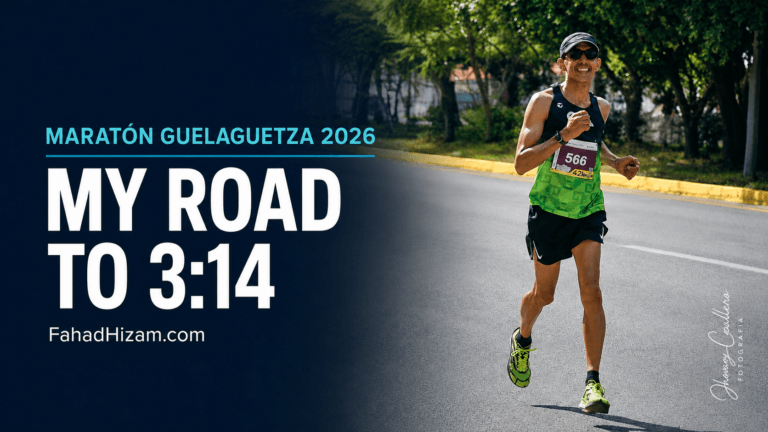

On October 14, 2024, I stopped a treadmill run after 63 metres. On July 26, 2026, I reached the standard marathon distance in 3:14:08 at the Maratón Internacional Guelaguetza in Oaxaca.
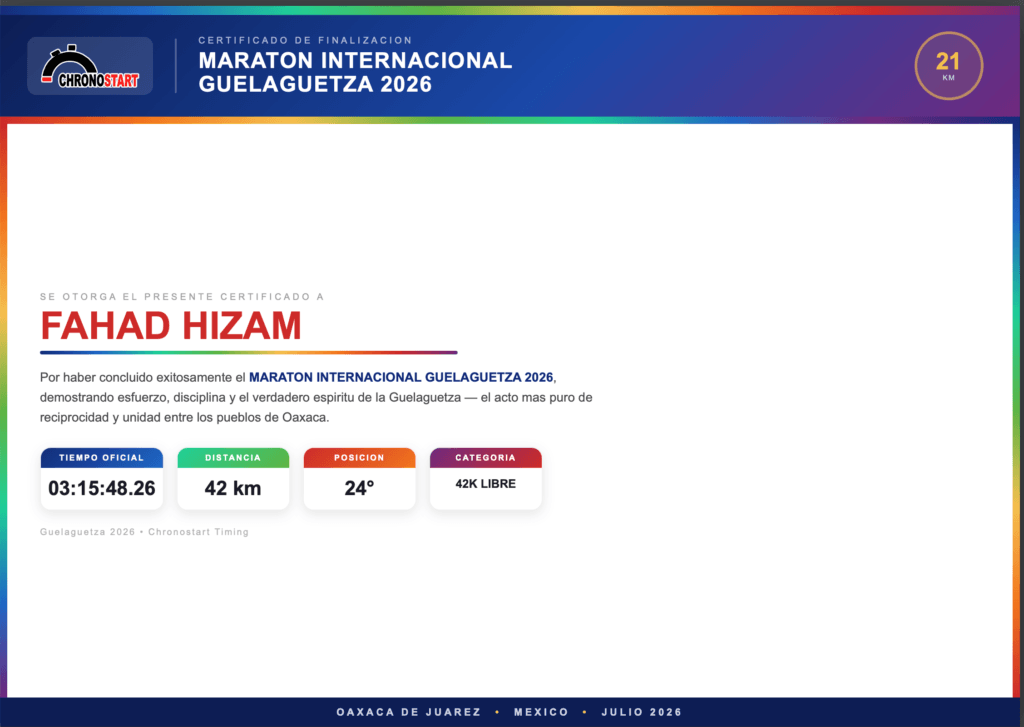
My official finish came soon afterward. Chronostart recorded a chip time of 3:15:48.26 and 24th place in the 42K Libre category, the open division for runners aged 18 to 44.
Data note: Chronostart is the source for my official time and position. Garmin and Strava supplied the GPS distance, pace, elevation, heart-rate and standard-distance figures. My training totals come from the activity files covering the final 24 weeks before the race.
My official Chronostart result covers the complete race. Inside the same GPS activity, Strava calculated 3:14:08 as my fastest marathon-length Best Effort.
Garmin recorded close to 42.55 kilometres. Its elapsed time at 42.195 kilometres was about 3:14:16, while Strava selected a slightly different section of the file and returned 3:14:08.
Three measurements, one race:
- 3:15:48.26: official chip time at the finish line.
- 3:14:08: Strava marathon Best Effort over 42.195 kilometres.
- About 42.55 kilometres: the complete path recorded by my Garmin.
I reviewed several public Garmin and Strava activities from other runners that also recorded around 42.5 kilometres, roughly 300 metres beyond the standard marathon distance. Personal GPS files cannot establish the official length of a course because turns, overtaking, road position, imperfect tangents and normal signal variation can all add distance. Still, the repeated pattern deserves review before the next edition.
The 3:14:08 Best Effort is the figure I use when comparing this race with my previous marathons. It improved my personal best by 11 minutes and 9 seconds and cut 34 minutes and 5 seconds from my first marathon in 2018.
The full marathon returns to Oaxaca
Oaxaca had gone almost a decade without hosting a full 42.195-kilometre road marathon. The state government and the Instituto del Deporte del Estado de Oaxaca brought the distance back under the name Maratón Internacional Guelaguetza.
The race took place on July 26, between the two Mondays of the Guelaguetza celebrations and one day before the Octava del Lunes del Cerro. The programme included 42K, 21K and 10K events, all centered on the Auditorio Guelaguetza.
Registration was free, and demand moved quickly. Organizers reported 24,000 registrations filled within six days, with entrants from all 32 Mexican states and 16 countries. The original projection had been around 15,000.
That number refers to registrations across the three distances. I haven’t found a reliable public breakdown of actual starters and finishers, so I don’t use 24,000 as a verified finisher count.
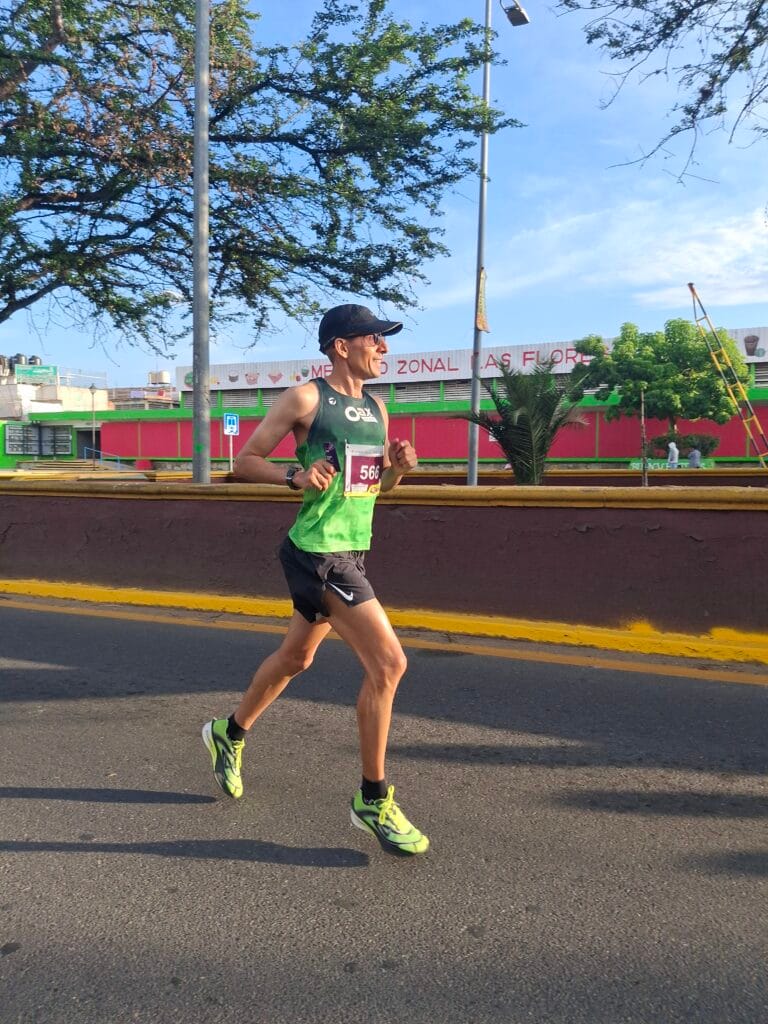
The official call included electronic timing for the 42K and 21K, road security, hydration, medical support, 10,000 official shirts and commemorative medals for the first 20,000 finishers. From inside the marathon field, the 42K start felt spacious and controlled. The shorter races followed in separate waves, and their runners never forced me away from the racing line.
Coming back from injury
My injury started during a road race in September 2024. Pain in my left foot developed into a stress fracture, and when I tested it on a treadmill on October 14, the run ended after 0.063 kilometres.
Sixty-three metres.
I also underwent carpal tunnel surgery on my left hand on January 11, 2025. Between the fracture, the operation and recovery, nearly five months passed without meaningful running.
The return began on February 26 with 1.7 kilometres on a treadmill. My first outdoor run followed on March 3 and covered 2.9 kilometres. Those were small distances, but every completed run gave me another piece of evidence that the foot could tolerate more.
In June 2025, I joined J.M. Aquino Athletic Club and finished the month with 195 kilometres. Coach Arnulfo brought structure to the training, which meant the easy running, intervals, hills, strength work, long runs and recovery finally had to fit together.
The largest training block I have completed
The final 24 weeks ran from February 8 through July 25, 2026. Race day is excluded from these totals.
| Training measure | Final 24 weeks |
|---|---|
| Running distance | 1,899.1 km |
| Weekly average | 79.1 km |
| Running days | 162 of 168 |
| Recorded run activities | 301 |
| Longest run | 32.0 km |
| Runs of at least 20 km | 8 |
| Highest week | 149.2 km |
| Strength-related sessions | 57 |
Several track workouts produced multiple files: warm-up, repetitions, recoveries and cooldown. That explains the 301 recorded activities. The 162 running days give the better measure of frequency.
The volume was around six times larger than the 24-week build before my first marathon, although the longest run did not increase by anything close to that amount. It moved from a little over 21 kilometres in 2018 to 32 kilometres in 2026.
Most of the difference came from frequency. Short treadmill runs after strength work added three or four kilometres at a time, and while none of them looked especially important alone, they changed the size of the block across several months.
In this essay · 17 sections
- Speed and long runs
- Altitude and strength work
- The late peak
- Start through 25 kilometres
- The fastest section
- The calves from 30 to 40 kilometres
- Fuel and support along the route
- The climb to the Fortín
- Registration and cost: 5/5
- Packet collection: 5/5
- Start organization: 5/5
- Course and traffic control: 4/5
- Aid stations: 5/5
- Marking and marshalling: 4/5
- Finish area: 4/5
- Results and timing: 4/5
- Overall: 5/5
Speed and long runs
A normal training period included 800-metre, 1,000-metre and 1,200-metre repetitions, midweek aerobic runs, fartlek sessions and a longer run on Sunday. The week could look crowded on paper, especially when one track session produced several activity files, yet the pieces had different jobs.
The long run had been the clearest weakness early in the build. I was accumulating high mileage through short runs and double-session days, though I still needed more continuous time under fatigue.
Sunday gradually moved from around 14 kilometres toward 30 and then 32 kilometres. Eight runs in the final block reached at least 20 kilometres. The shorter days built frequency; the longer ones tested what remained after two hours.
Altitude and strength work
The full block took place in Oaxaca, usually between 1,530 and 1,560 metres above sea level, while mountain sessions reached close to 3,290 metres. Easy pace feels different there, recovery between hard repetitions takes longer, and even modest hills disturb rhythm.
That environment matched the race well. The marathon also ran at altitude, over rolling roads, with a long climb waiting at the end.
I completed 57 strength sessions during 20 of the final 24 weeks with Neto Carranza at Halcones CECAFID. The work focused on the calves, ankles, hips, glutes, hamstrings, quadriceps and trunk because the real test was whether I could absorb frequent impact and still run the next day.
I also entered race week managing C5-C6 nerve pain. It had disrupted part of the final build, though it did not become a major problem during the marathon.
The late peak
The two heaviest weeks arrived close to race day: 139.1 kilometres from June 28 through July 4, followed by 149.2 kilometres from July 5 through July 11. That second week ended with 27.7 kilometres on the trails at Santa Catarina Ixtepeji.
Then my body pushed back.
On July 15, I stopped a session because my legs felt unusually heavy. Two days later, even an easy jog felt wrong, despite the absence of illness or a new running injury. The accumulated load had caught up with me.
The final two weeks dropped to 90.4 and 65.9 kilometres. Rest improved the legs, though I never found the freshness I had expected from the taper. The volume gave me durability, and its timing left room for improvement.
The Acreimex test five weeks earlier
Five weeks before the marathon, I ran the Acreimex Oaxaca 21K.
Strava found a 1:27:44 half-marathon Best Effort inside an activity that recorded longer than the standard 21.0975-kilometre distance. I keep that distinction clear: the 1:27:44 figure covers a standard-distance segment inside the GPS file, rather than proving that the complete event route measured exactly one half marathon.
A basic Riegel projection from 1:27:44 gives a theoretical marathon near 3:02:55. That number confirmed the improvement in my aerobic condition, though it could not account for the Oaxaca marathon’s altitude, wind, rolling profile, rising temperature or the final climb to the Fortín.
The 3:09 race plan
I finalized the pacing plan at about 3:35 a.m. on race morning after reviewing the latest wind output from ECMWF, ICON and GFS.
| Target | 3:09:00 |
|---|---|
| Average pace | 4:29/km |
| Planned distance | 42.2 km |
| Pacing sections | 14 |
The plan changed pace with the terrain and expected wind instead of prescribing 4:29 for every kilometre. Faster sections appeared where the course allowed them, with more time reserved for the climbs and exposed return.
The final forecast called for a temperature near 16.5°C at the start and close to 23°C by the finish. Rain looked unlikely. Wind was expected from the north-northwest at 4 to 9 km/h, with less favourable exposure on much of the route back toward Oaxaca.
The important points were the G500 turnaround near kilometre 23.7, the eastern highway on the return and the start of the Fortín climb around kilometre 41. Garmin’s race predictor had stayed between 3:10 and 3:12 through July, reaching 3:10:13 on July 11 and showing about 3:12 on race morning.
Juan paced me in two separate sections: kilometre 10 through kilometre 20, then around kilometre 28 through the finish. Together, those sections added up to about 25 kilometres.
Race morning and the route
My recorded warm-up began at 5:18 a.m. It covered 4.54 kilometres and climbed around 98 metres from the lower part of the city to the start area near the Auditorio Guelaguetza.
The 42K started at 6:30 a.m. The shorter races followed in separate waves.
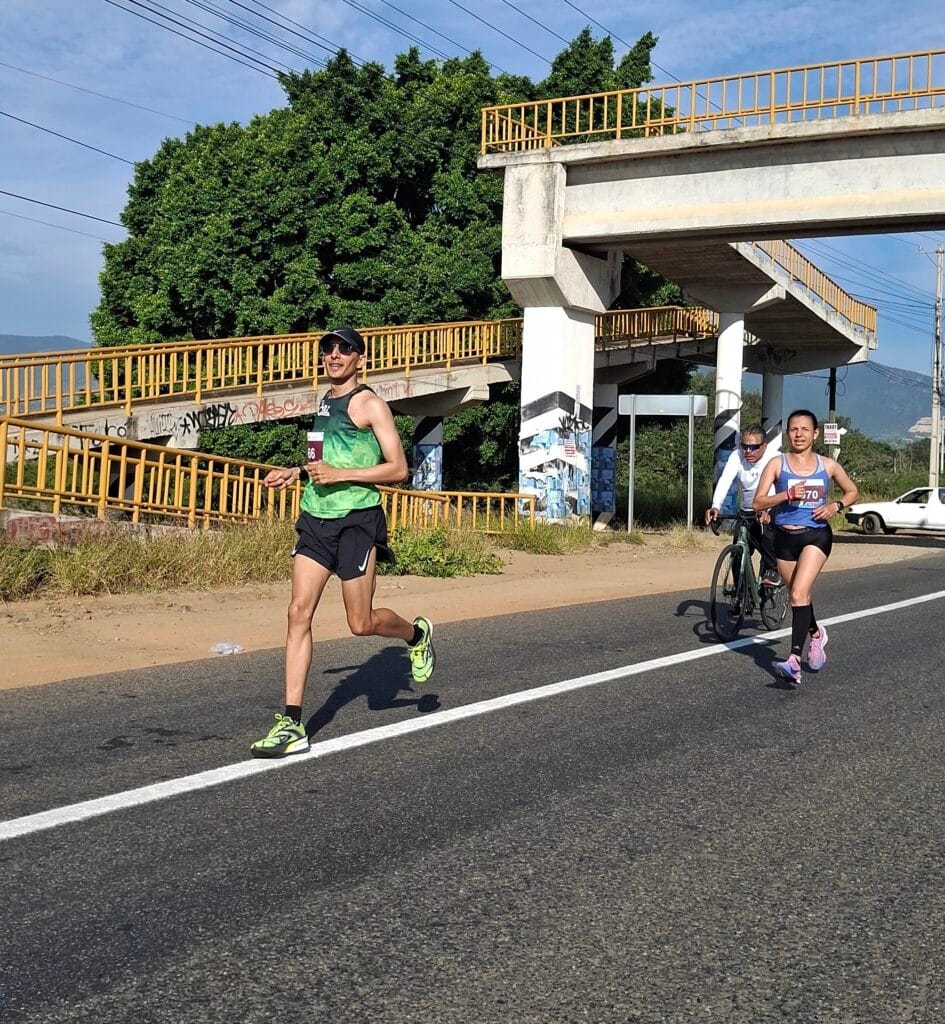
From the Cerro del Fortín, the marathon descended into central Oaxaca and continued east through San Francisco Tutla. The road then carried us toward Tlacolula, with a turnaround near the G500 station in San Francisco Lachigoló before the long return to the city.
And then the climb back to the Auditorio.
The eastern kilometres were exposed, with long stretches of road and little shade. My watch recorded an altitude range of about 1,550 to 1,643 metres and 274 metres of ascent. Throughout my race, the roads were effectively closed, and I never had to negotiate live traffic.
I raced in Nike Vaporfly 4 shoes and used a Garmin Forerunner 165.
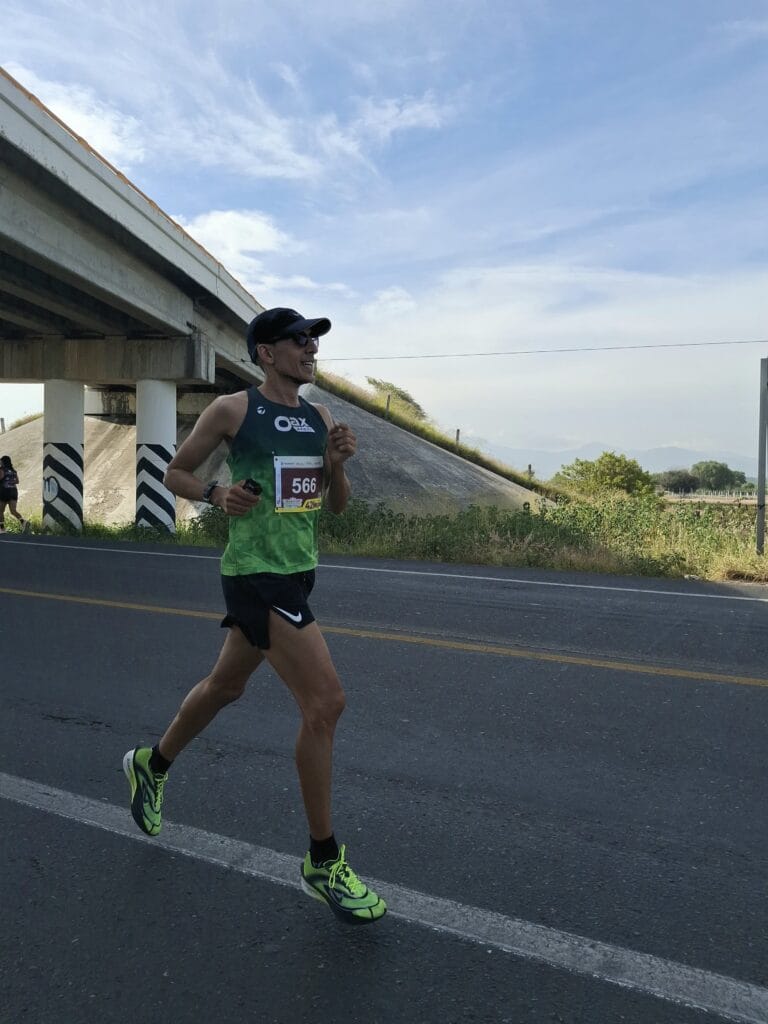
The complete Strava activity
The activity below contains the GPS route, recorded distance, pace, elevation and kilometre splits. Strava calculates Best Efforts from standard-distance sections inside a complete activity, which explains why the marathon Best Effort and official finish time differ.
How the race unfolded
Start through 25 kilometres
The opening five 5K blocks stayed inside a fairly narrow range, even though the terrain and road exposure changed:
| Section | Time | Average pace |
|---|---|---|
| 0-5 km | 22:37 | 4:31/km |
| 5-10 km | 23:04 | 4:37/km |
| 10-15 km | 22:42 | 4:32/km |
| 15-20 km | 22:45 | 4:33/km |
| 20-25 km | 23:12 | 4:38/km |
At 10 kilometres, I was 41 seconds behind the 3:09 schedule. Juan joined me there and stayed through kilometre 20, covering the city and the beginning of the eastbound road.
Garmin’s analysis placed the first standard half at about 1:36:22 and the second at 1:37:54, a positive split of around 1 minute and 32 seconds. Together they total about 3:14:16, while Strava’s 3:14:08 Best Effort uses slightly different points inside the same GPS file.
The effort still felt controlled. Trying to recover the full deficit before the turnaround would have spent energy that I expected to need later.
The fastest section
The strongest 5K came between kilometres 25 and 30: 21:47, or close to 4:21 per kilometre. Kilometre 29 was faster again at 4:14.
Juan rejoined me at around kilometre 28 and stayed through the finish. By 30 kilometres I was 2 minutes and 7 seconds behind the 3:09 schedule, still moving well enough to keep the race together, although the calves were beginning to change.
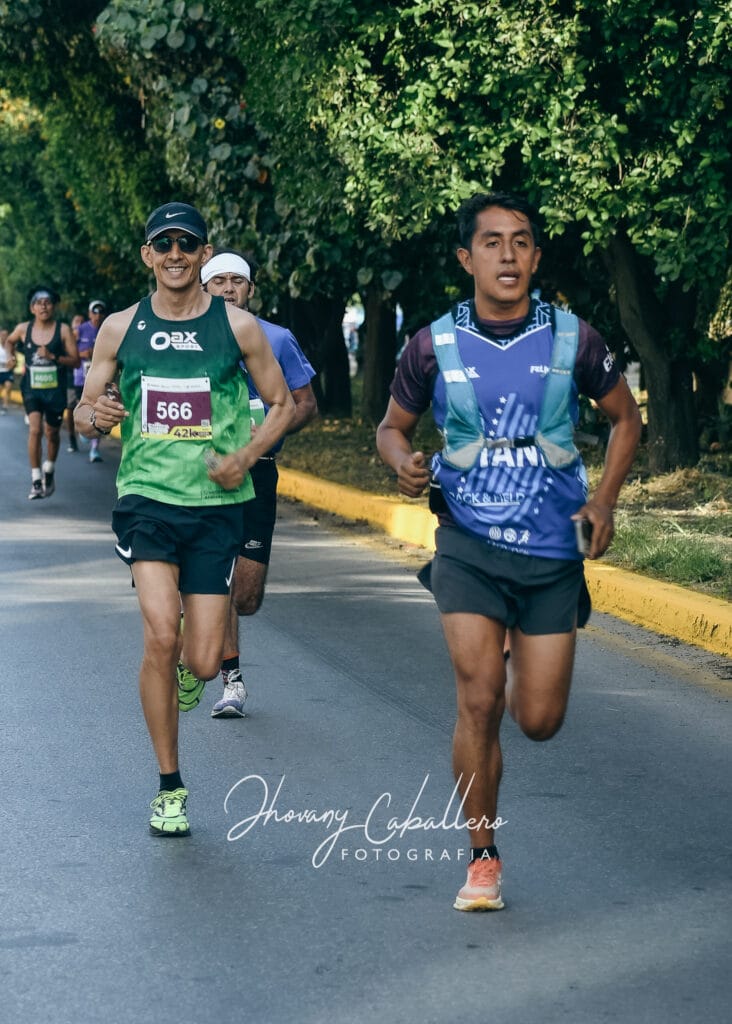
The calves from 30 to 40 kilometres
The calves began losing strength around kilometre 30. There was no sudden cramp or dramatic stop; each small rise simply demanded more force than the previous one, and the stride became shorter as the return progressed.
| Section | Average stride length |
|---|---|
| 25-30 km | 137.4 cm |
| 30-35 km | 126.0 cm |
| 35-40 km | 122.7 cm |
Cadence stayed near 170 to 172 steps per minute. The turnover remained, but each step covered less road.
The 35-to-40-kilometre block took 23:55, close to 4:47 per kilometre. I had allowed about 44 minutes for kilometres 30 through 40; the section took around 47.
The kilometre paces make the slowdown visible: 4:33, 4:35, 4:42, 4:46, 4:30, 4:35, 4:42, 4:47, 4:49 and 5:02. Kilometre 40 was the first one slower than five minutes.
I had no stomach trouble, dizziness, bathroom stop or shoulder flare-up. The restriction was muscular. By then, the calves could no longer produce the stride length needed for the original pace.
Fuel and support along the route
During the marathon, I used six GU Energy gels and one packet of GU Roctane carbohydrate mix prepared in 200 ml of water.
Jeanine personally donated GU Energy products to Oax Sport, and I used some of them during the build and marathon. She made the donation independently and has no affiliation with GU Energy.
Diana supported me at different points along the course and helped with fueling. Coach Arnulfo was also present at several points, which made the exposed eastern section feel less isolated and simplified the practical side of race support.
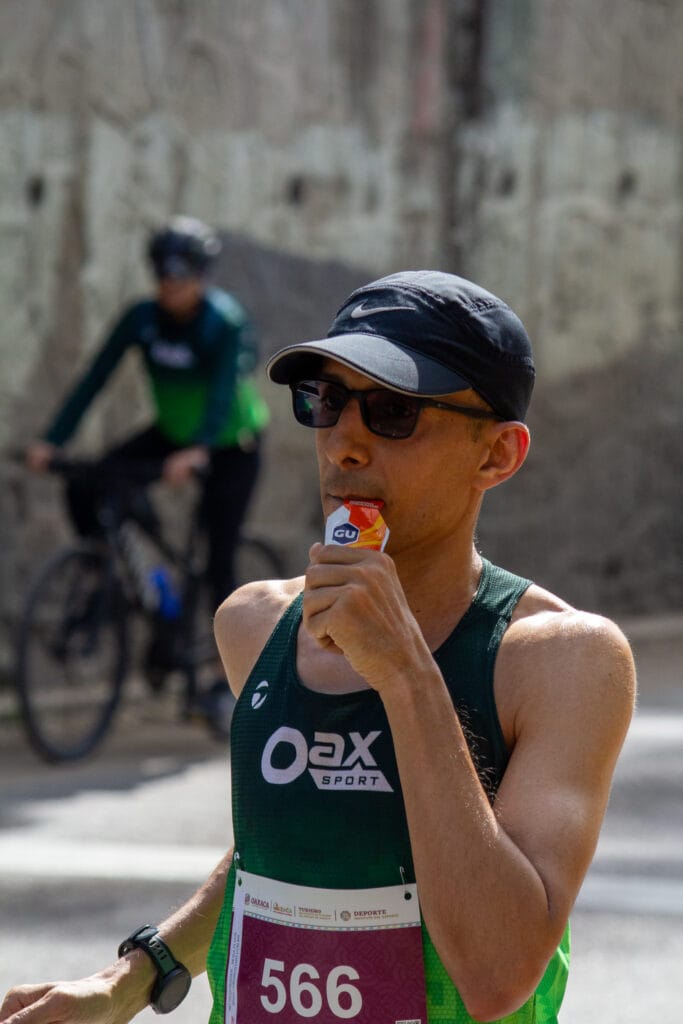
The climb to the Fortín
The final climb began around kilometre 41. My plan estimated 65 metres of ascent over the last 2.2 kilometres, while the activity recorded about 73 metres of net climbing over the final 2.5.
Stride length had fallen to around 116 centimetres. At the same time, running power rose to about 311 watts as the gradient increased.
| Section | Time | Pace | Elevation gained |
|---|---|---|---|
| 41.0-41.5 km | 2:36 | 5:12/km | 21 m |
| 41.5-42.0 km | 2:49 | 5:38/km | 30 m |
| 42.0-42.5 km | 2:32 | 5:04/km | 22 m |
The half-kilometre from 41.5 to 42.0 was both the steepest sustained part and the slowest sustained pace of the race. By then, comparisons with flat-road pace had stopped being useful. I kept running and climbed.
Strava recorded 3:14:08 for the marathon distance. Chronostart stopped the official chip at 3:15:48.26.
What the result says
The race plan was 3:09:00. My Strava marathon Best Effort finished 5 minutes and 8 seconds outside that plan, while the official result was 6 minutes and 48 seconds outside it and 5 minutes and 48 seconds beyond a sub-3:10 finish.
I missed the target.
The race still produced an 11-minute personal best on the hilliest marathon course I have completed, after a stress fracture, surgery and nearly five months without running. Strava also identified a new 30K Best Effort of 2:15:56, improving my previous recorded 30K best of 2:23:04 by 7 minutes and 8 seconds.
The slowdown came through a progressive loss of stride length rather than one catastrophic kilometre. That matters for the next preparation because the aerobic condition held longer than the calves did.
The adjusted performance
I used Enduraw to estimate how altitude, elevation and wind affected the 3:14:08 standard-distance result. Its calculation returned an adjusted equivalent of 3:04:32, close to 4:23 per kilometre.
The figure is a performance estimate. My official result remains 3:15:48.26, and 3:14:08 remains the Strava marathon Best Effort inside the activity.
A race near 3:05 next year will require a better taper, stronger calves after 30 kilometres and a complete performance on the road. The time still has to be run.
The people behind the race
Coach Arnulfo and J.M. Aquino Athletic Club gave the comeback a plan and a training group. Neto Carranza at Halcones CECAFID fitted 57 strength sessions into 20 of the final 24 weeks and kept that work connected to the running load.
Dr. Roberto and Dra. Laura of Clínica Médica Ángelus managed my medical care during the preparation.
Juan paced me from kilometre 10 to kilometre 20, then again from around kilometre 28 through the finish, about 25 kilometres in total. Diana supported me at different points and helped with fueling.
Jeanine supported Oax Sport with an in-kind donation of GU Energy products. She made the donation personally and has no affiliation with GU Energy.
My family, teammates and the wider Oax Sport community stayed involved from the first short runs after injury through race morning.
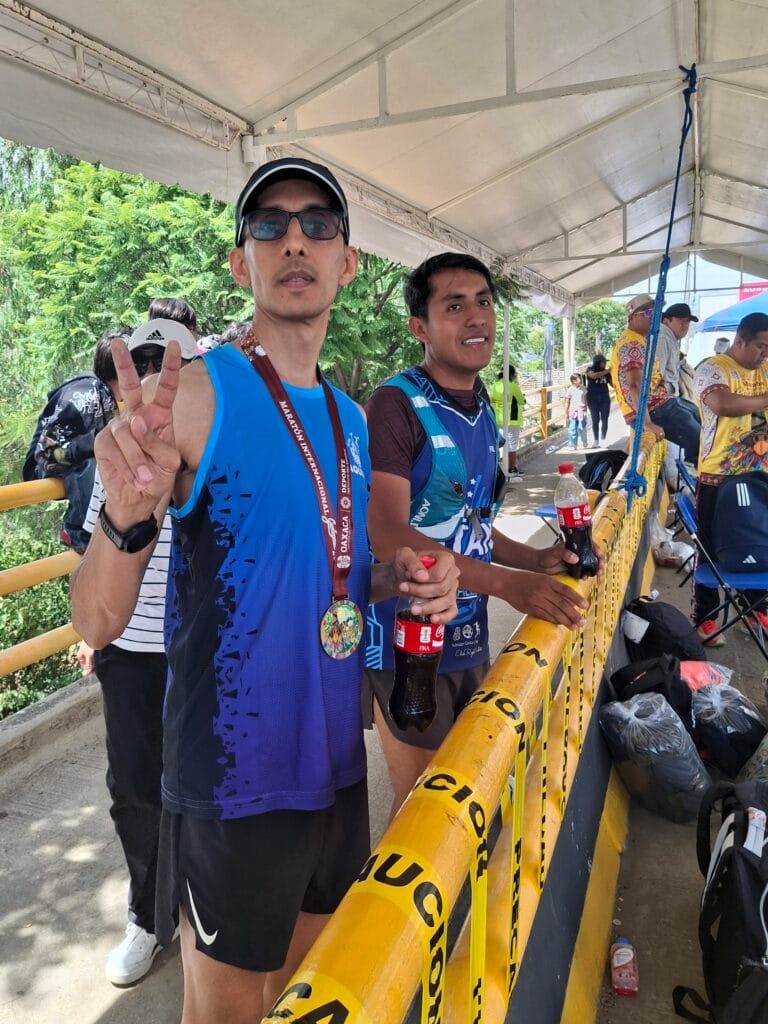
My review of the event
These scores reflect my experience as a 42K runner. Someone in the 10K, the half marathon or a later finishing group may have seen a different event.
Registration and cost: 5/5
Free registration removed a real financial barrier, and the process itself was quick and clear. Managing 24,000 registrations across three distances created pressure, yet I had no problem completing mine.
Packet collection: 5/5
My visit to the Complejo Deportivo Hermanos Flores Magón was straightforward. The shirt, number and timing chip were correct, the line moved, and I left without an unresolved question.
Start organization: 5/5
Space. That was the first thing I noticed.
The 42K field settled into pace without crowding, while the shorter races followed in separate waves. I never had to work through a large group from another distance, which made the opening kilometres much easier to control.
Course and traffic control: 4/5
The route connected the Cerro del Fortín, central Oaxaca, the eastern highway and communities toward Tlacolula. Police, volunteers and medical personnel were visible, and the roads were effectively closed during my race.
The missing point concerns measurement transparency. My watch and several other public GPS activities recorded around 42.5 kilometres. GPS cannot settle the question, so a published professional measurement record would remove the uncertainty.
Aid stations: 5/5
Water and sports drink were available when I reached the stations on both the outbound and return sections. Some locations also had food, and I did not encounter an empty station during my race.
Marking and marshalling: 4/5
I had no problem following the course or handling the G500 turnaround. The route direction was clear.
Kilometre boards were the missing element. Runners without a GPS watch had no dependable official reference for pacing or remaining distance.
Finish area: 4/5
Medal distribution and timing worked during my finish, and family access did not create a problem. Music, regional dress and other cultural elements gave the Auditorio area a clear Oaxaca identity.
Cold drinks became limited. After several hours under the July sun, runners needed colder water, sports drink and ice.
Results and timing: 4/5
Chronostart published my individual result and downloadable certificate quickly. Five days later, however, I still could not find an easily accessible complete 42K standings table, which matters for athletes, journalists and the historical record.
Overall: 5/5
Oaxaca brought the full marathon back, kept entry free, controlled the roads, supplied the aid stations and attracted registrations from every Mexican state and 16 countries. The next edition should add kilometre boards, publish the course measurement, improve cold finish-line hydration and release complete results sooner.
The main operations worked. I plan to enter again in 2027.
Leading performances
Local post-race reporting identified Arturo Álvarez of Guerrero as the men’s marathon winner in 2:23:34. Reynaldo Pacheco Rojas was reported as sixth overall and the first Oaxacan man.
Claudia Martínez Morales was reported as the first Oaxacan woman and third woman overall in 2:56:22. I haven’t found a complete authoritative public table for both 42K fields, so this section is limited to the placements supported by published reports.
In memory of four runners
Four members of the Xuta Xi Manga athletics club died in a road crash while returning home after the event: Georgina Luis Espiridión, Patricia Feliciano Lázaro, Adelaida Ortiz Olguín and Sofía Jiménez Felipe.
The crash occurred away from the race course during their return toward San Miguel Soyaltepec. Their deaths affected the wider Oaxaca running community, and their names belong in the record of the weekend.
What I need for 3:05
On October 14, 2024, I stopped after 63 metres. I restarted on February 26, 2025, with 1.7 kilometres on a treadmill, and on July 26, 2026, Strava recorded 3:14:08 for the standard marathon distance while Chronostart recorded 3:15:48.26 at the finish.
Between those dates came a stress fracture, hand surgery, 1,899.1 kilometres of training, 57 strength sessions, mountain trails, two heavy peak weeks and a taper that never felt completely comfortable. The race missed the 3:09 plan, and it also showed exactly where the preparation held and where my body began to lose the argument.
Next year’s work is clear: recover better from the peak block, keep the calves functioning beyond 30 kilometres and move the marathon closer to 3:05.
For now, 3:14:08 is the strongest marathon I have run.
Fahad Hizam
Oaxaca de Juárez, Mexico
Training and race data from Garmin, Strava, Chronostart and Enduraw
More running articles | Oax Sport
Sources
- Chronostart: Fahad Hizam’s official Maratón Internacional Guelaguetza 2026 result
- Government of Oaxaca: official Maratón Internacional Guelaguetza 2026 call
- El Imparcial de Oaxaca: return of the full marathon after almost a decade
- El Imparcial de Oaxaca: 24,000 registrations and entrants from 16 countries
- Government of Oaxaca: route and traffic-control plan
- Strava: how running Best Efforts are calculated
- Primera Línea: Xuta Xi Manga athletes killed in a road crash after the event
- Enduraw performance adjustment model
Last updated: September 30, 2026

Private investigator and criminal-justice researcher based between Mexico City and Oaxaca. He works on financial crime, due diligence, and asset tracing, and writes on policing, organized crime, corrections, and the law in three languages. More about Fahad →
Get the next essay by email.
One email each time I publish a new essay. Unsubscribe anytime.
SubscribeDiscover more from Fahad Hizam alHarbi
Subscribe to get the latest posts sent to your email.