

In 2024, I ran Acreimex Half Marathon in 1:32:16. In 2025, I did not run Acreimex Half Marathon. I was injured.
In 2026, I came back and ran Acreimex 21k in 1:27:44 according to Strava. The same activity recorded a 20 km best effort of 1:23:06. The cleanest comparison is the 20 km best effort: in 2024, Strava gave me 1:28:21 for 20 km, and in 2026 it gave me 1:23:06. That is 5 minutes and 15 seconds faster over the same distance.
That number explains the improvement better than the official clock alone.
The 2026 course measured long. My Strava file recorded about 21.65 km, roughly 550 meters over the standard half-marathon distance, and that extra distance affected the time for everyone. The official race result listed my chip time as 1:30:07 and placed me 39th overall, 36th among men, and 14th in the Master Men 40–49 category.
Acreimex 21k is one of Oaxaca’s recurring road races, organized as the Medio Maratón Internacional ACREIMEX. The 2026 race was the ninth edition and included 5K, 10K, and 21K distances in Oaxaca. For local runners, it is a familiar mid-year test because it combines city streets, altitude, rolling sections, and a competitive field.
Acreimex 2024 was a solid race
My 2024 race was solid. The race felt controlled, and I finished in the 1:32 range, similar to the year before. I left with the sense that I had built a better base.
The race was well organized. The weather was cloudy and calm, and the route through Oaxaca passed places I know well, including El Llano, Macro Plaza, Cerro del Fortín, Mercado de Santa Rosa, and Macedonio Alcalá. Looking back, Acreimex Half Marathon 2024 was the last clean race before the injury period.
The injury changed the next year
After the 2024 race, my running volume dropped because my left foot started hurting. The Garmin log shows the pattern clearly: my last real run before the collapse was on September 22, 2024. The 63-meter test on October 14 showed the foot problem had taken over.
The injury became a left foot stress fracture, in plain language, a broken bone in my foot. At the same time, I was dealing with left carpal tunnel syndrome, and I had surgery on January 11, 2025. Running effectively stopped for almost five months.
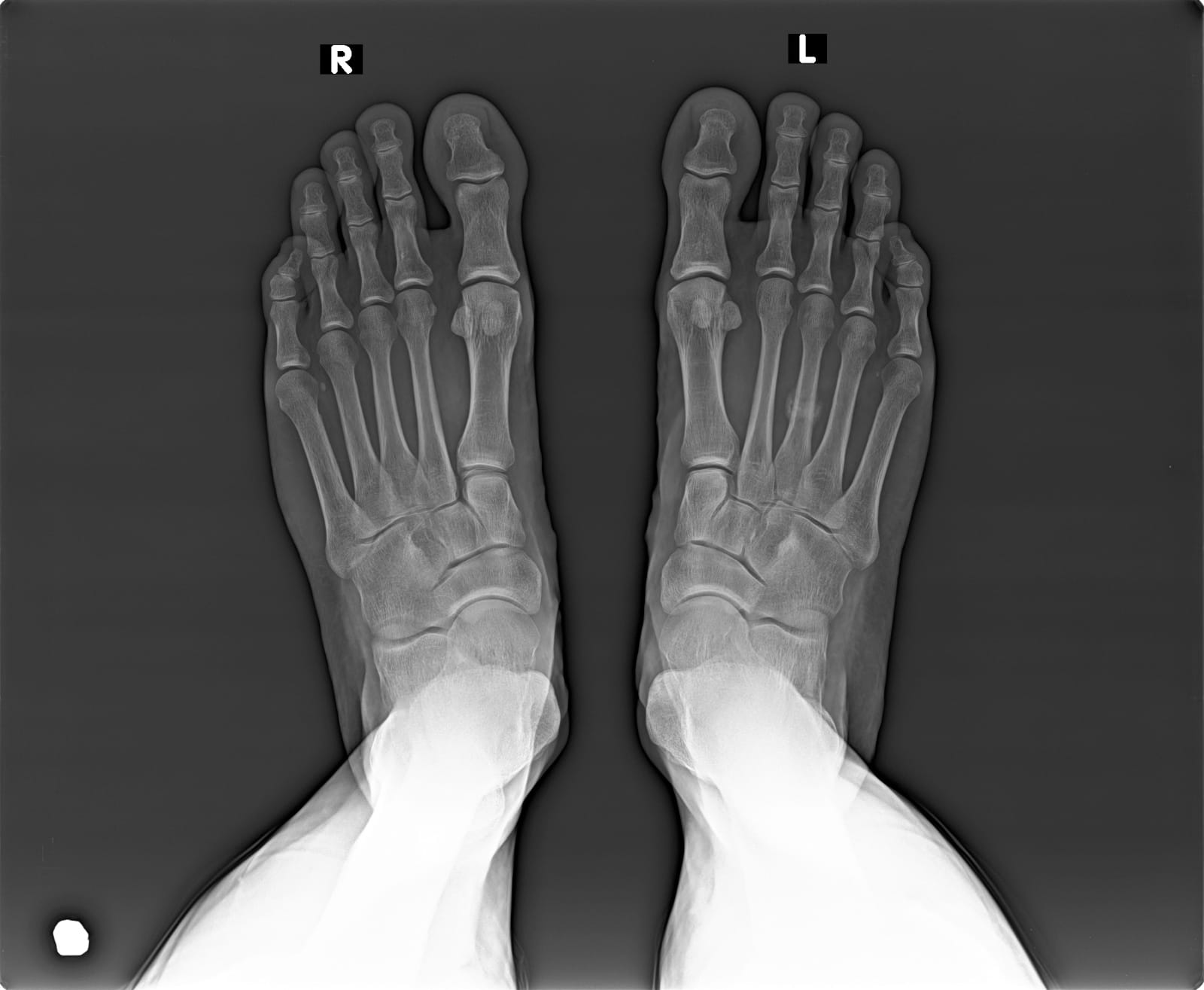
Dr. Roberto García García supported me through the foot and nerve issues during that period. His guidance mattered because I was trying to return to running without turning the injury into a longer problem.
The first real treadmill session back came on February 26, 2025. The first real outdoor run came on March 3, 2025. A race result gives the final time. It leaves out the period of tests, pain, uncertainty, and careful returns behind it.
I missed Acreimex Half Marathon 2025 because I was injured.
That missed race belongs in the story. It sits between the 1:32:16 in 2024 and the 1:27:44 Strava half-marathon best effort in 2026.
The return, month by month
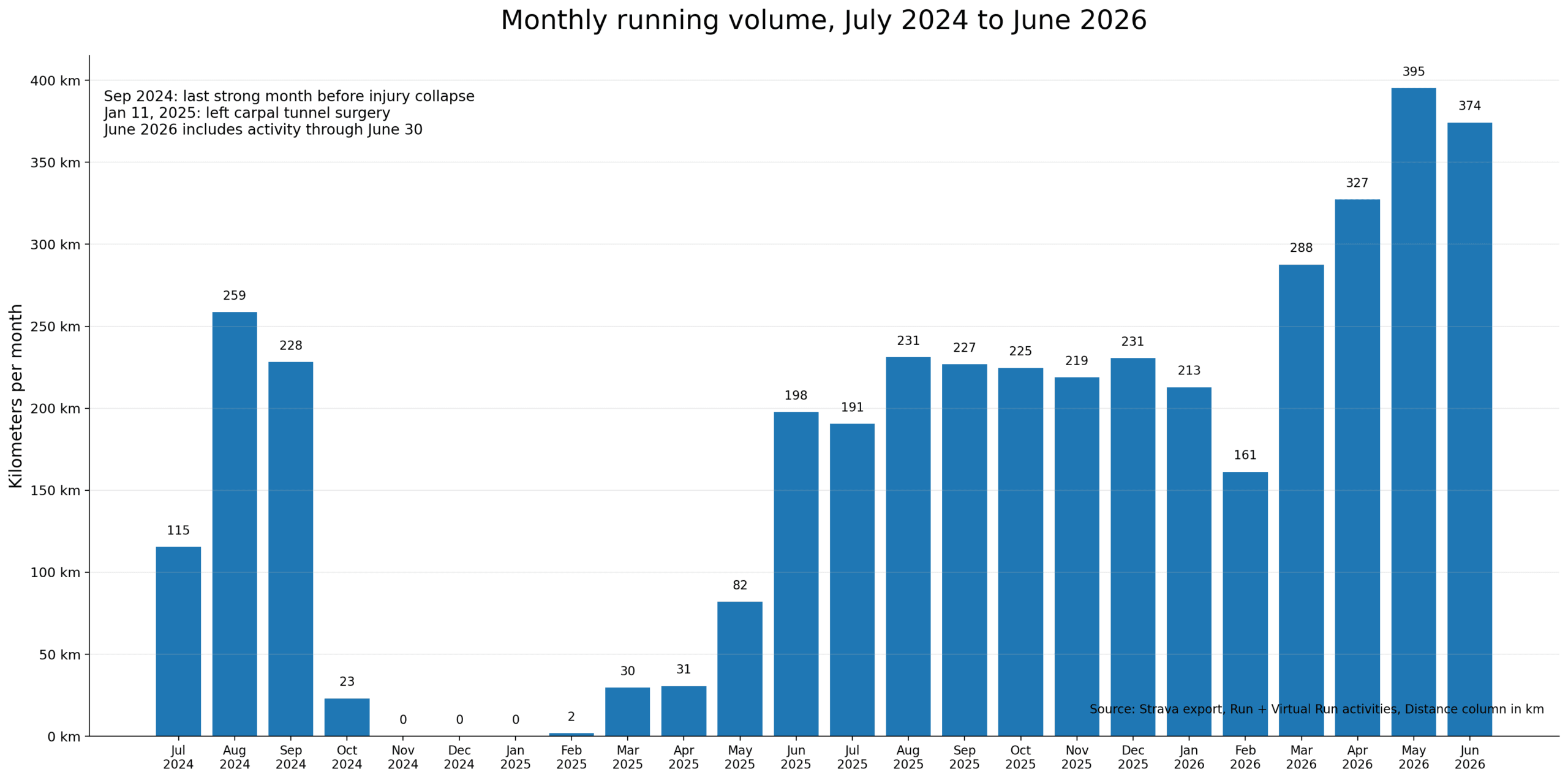
The comeback did not move in a straight line. Late 2024 collapsed after the foot pain. November and December had no real running, early 2025 was cautious, and March brought the first outdoor return. By May and June 2025, the rebuild became consistent.
October and November 2025 were real training months, around 215 km and 219 km. December reached about 237 km. January and February 2026 were uneven, with February dropping because of the Mitla Mountain Race and the way that month was structured. After that, the Acreimex build surged.
March, April, and May 2026 became the main block. Volume increased, sessions became more specific, and the work aligned with the race. The difference was clear in the final 12 weeks before Acreimex: before Acreimex Half Marathon 2024, I ran about 586 km in the final 12 weeks, around 49 km per week. Before Acreimex 21k 2026, I ran about 964 km in the final 12 weeks, around 80 km per week.
That is the central training difference. I was able to handle much more running before the 2026 race.
The daily time cost of training
The Garmin file records the run or the gym session. It does not record everything around it. A normal training day takes more time than the activity duration, with preparation before leaving, the warm-up, the actual session, the cool-down, stretching, showering, eating, and recovering enough to function afterward.
Gym days also take setup time, travel time, mobility work, and the mental shift from work mode into training mode. During the larger 2026 block, many training days required two to three hours of total attention: travel, warm-up, the session, cooldown, and recovery. Longer sessions could take more.
That daily time cost matters. Consistency is hard because the kilometers take real space in the day beyond the workout itself.
Strength work stayed in the picture
The gym remained part of the routine. Before the 2024 race, I had about 29 strength sessions in the final 12 weeks. Before the 2026 race, I had about 23, and total strength time was similar, around 22 to 23 hours in both builds. That matters because it keeps the explanation balanced.
The gym supported the running. The larger change came from running volume, session structure, and consistency. Strength training with Halcones and Ernesto “Neto” Carranza stayed part of the system, and it helped maintain durability as the running load increased.
The 2026 work was more specific
By 2026, the training was closer to race demands. There were more sustained efforts, longer intervals, and sessions that required holding pace under fatigue. The structure moved beyond general fitness and became specific to the half marathon.
That matters for a race like Acreimex in Oaxaca. It is fast but requires control and strength in the final section. My 2026 Strava 20 km best effort shows that difference: I covered 20 km in 1:23:06, compared with 1:28:21 in 2024. That is a pace shift from about 4:25 per km to about 4:09 per km.
Course conditions and adjusted pace
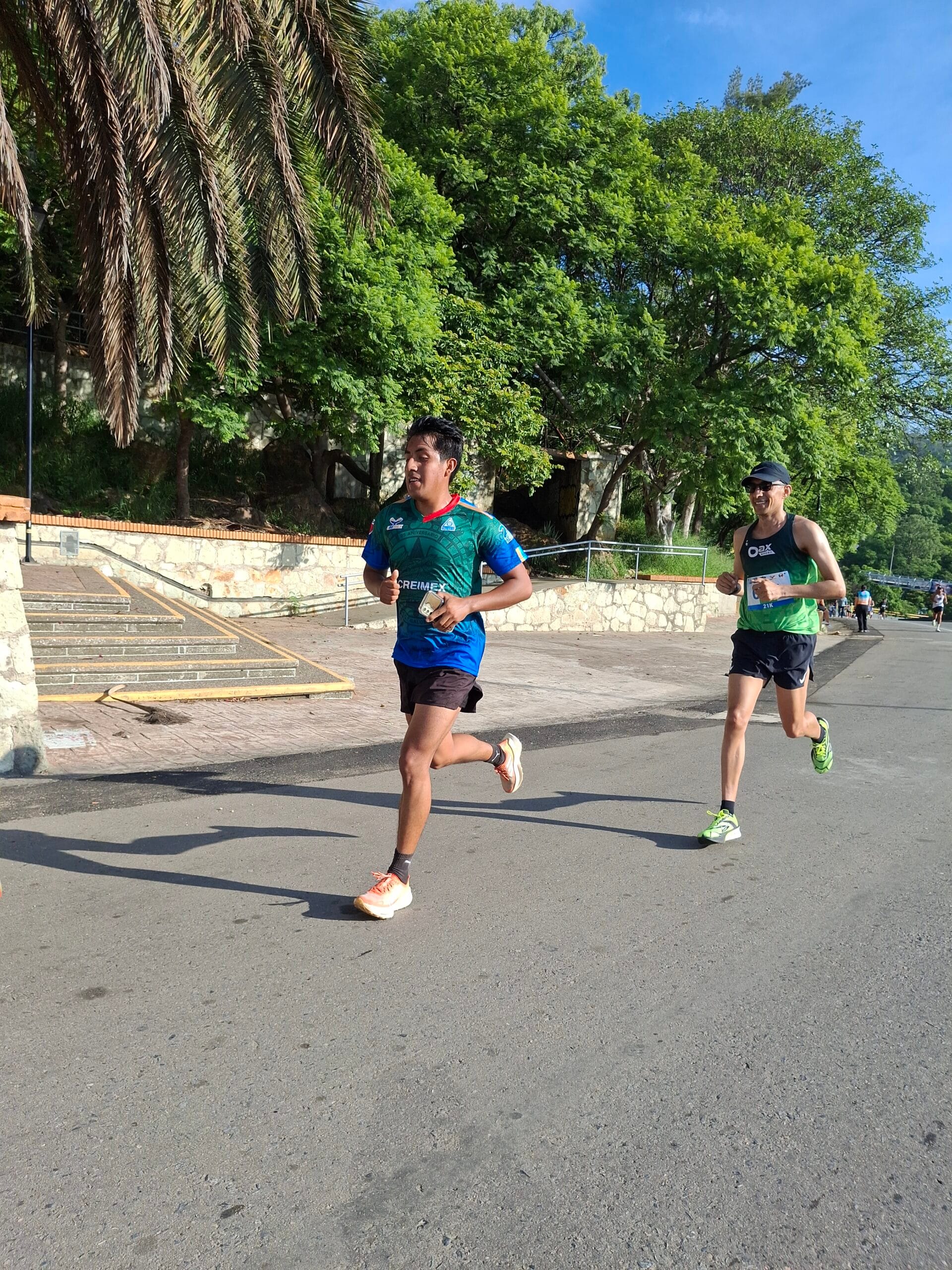
The 2026 race was also affected by course and environmental conditions. The route had an average elevation grade of 0.8%, and the average altitude was about 1,571 meters. The temperature was 16.5°C, with wind around 5.0 km/h.
The altitude file shows two main climbing sections. The first was an early rolling climb around km 1.5 to km 2.5. The larger climb came around km 10.6 to km 12.2, where the route rose about 72 meters and reached the highest point of the activity near 1,644 meters. After that, the file shows a long descent between roughly km 13 and km 14.3.
Based on the adjusted-pace estimate, elevation cost about 3 seconds per kilometer, altitude cost about 8 seconds per kilometer, heat cost about 1 second per kilometer, and wind cost about 2 seconds per kilometer. Under standard conditions, the estimate showed a possible gain of 4 minutes and 48 seconds.
The adjusted pace came out to 3:57 per kilometer. The same estimate placed energy cost between 1,118 and 1,367 kcal, with fluid loss between 0.6 and 1.2 liters, using an estimated sweat rate of 0.6 liters per hour.
Similar weight
My weight was similar across both builds. Around the 2024 race, my weekly average stayed between 56.5 kg and 56.9 kg. My BMI was around 19.3 to 19.5, with body fat readings around 6.0%. My weight stayed similar in both builds, and the change came from the work I could absorb.
Nutrition became more consistent
My nutrition became more consistent. I paid more attention to carbohydrates, protein, recovery, hydration, and avoiding under-fueling. Supplements were part of the routine, including protein, creatine, collagen, magnesium, and basic daily support. The main improvement was consistency around training.
A larger training block only works if recovery keeps up. That became clearer after the injury. I could not treat food, sleep, and recovery as secondary while asking my body to handle 80 km weeks.
J.M. Aquino changed the environment
Changing to J.M. Aquino mattered. Coach Arnulfo Morales provided structure, and the group around me changed the rhythm of my training. Many of the athletes were masters runners, mostly in their 30s, 40s, and 50s. Training in that environment shifted my routine toward steady work and fewer isolated peak efforts.
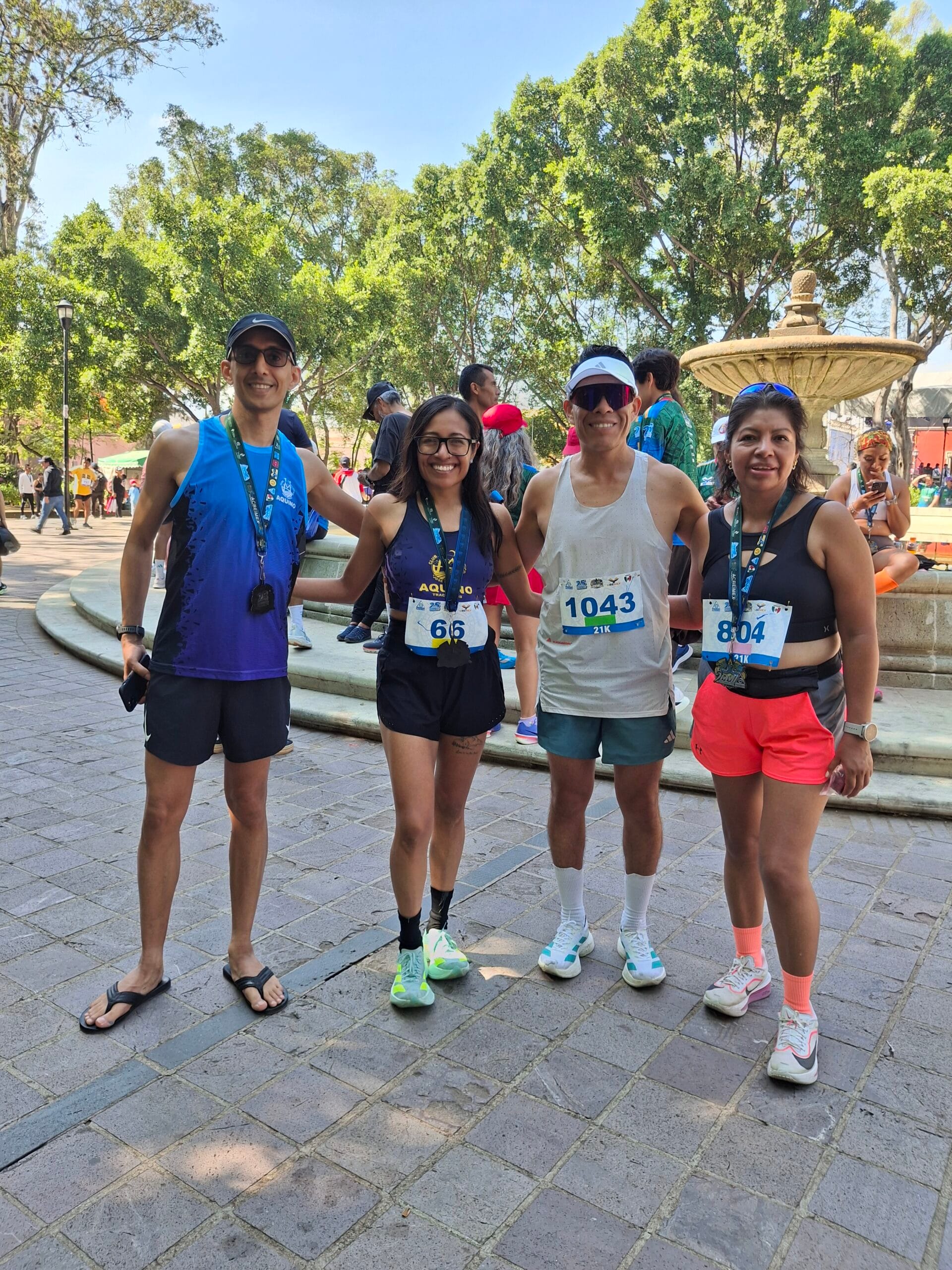
Experienced runners train differently. They know when to push and when to repeat consistent work. That shifted my attention from single workouts to cumulative weekly volume. Ernesto “Neto” Carranza and Halcones kept strength and conditioning in place, while Dr. García at Clínica Médica Ángelus added medical accountability, a reminder that the body has limits.
Race-day support also mattered. Juan Victoria, supporting as an Oax Sport volunteer, was part of the 2026 experience. The result felt personal, but it was not isolated from the people around the race.
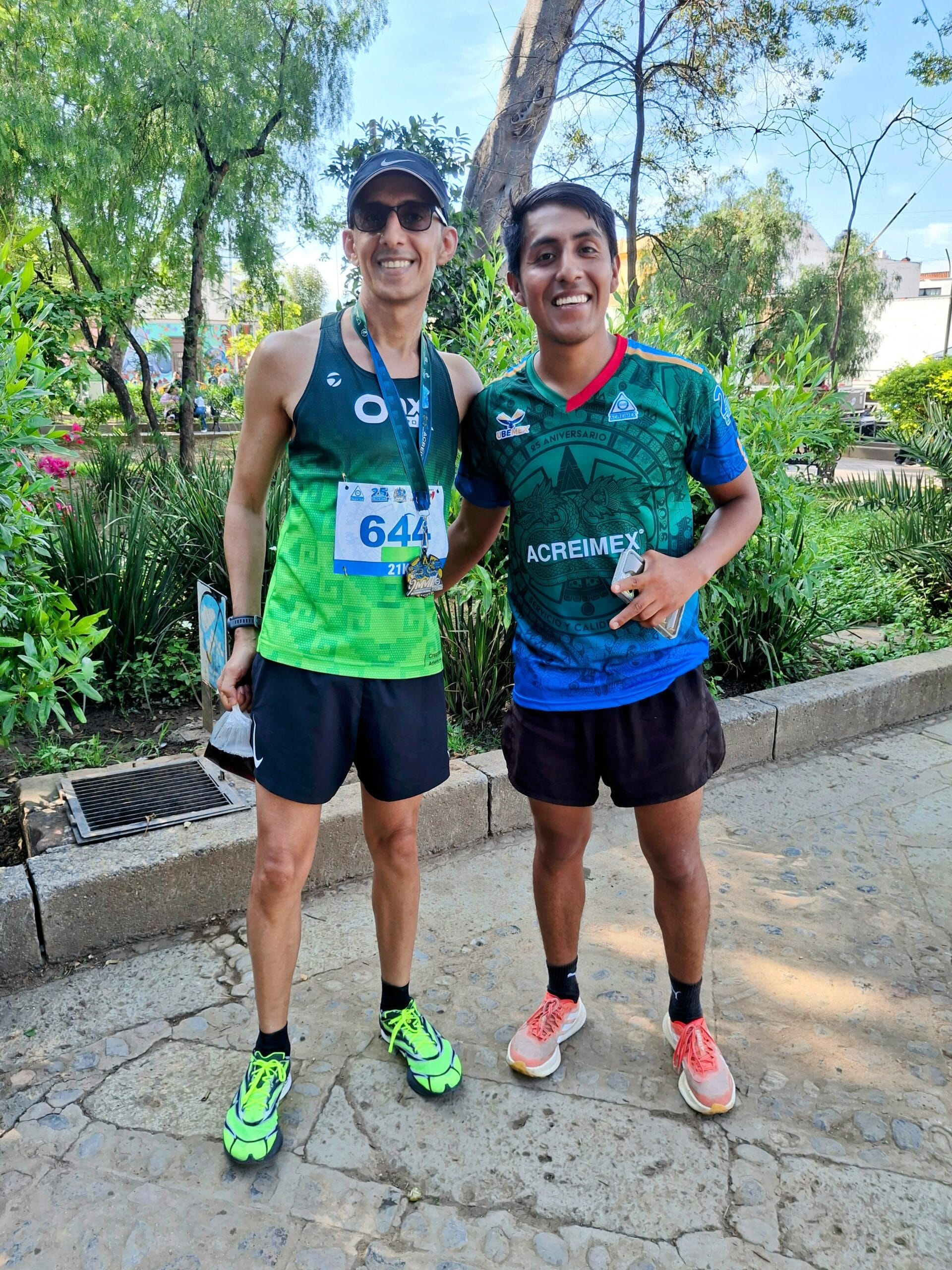
The 2026 race
The 2026 Acreimex 21k result was 1:30:07 by chip time. My official classification placed me 39th overall, 36th among men, and 14th in Master Men 40–49.
| Point | Overall position | Men’s position | Category position | Time | Split |
|---|---|---|---|---|---|
| 6.22 km | 60 | 50 | 21 | 25:46 | 25:37 |
| 15.6 km | 43 | 38 | 15 | 1:05:37 | 39:51 |
| Finish | 39 | 36 | 14 | 1:30:07 | 24:39 |
The final section slowed, but I still gained places. This detail shows the race was about pace, positioning, effort management, and staying competitive on a long course.
How I read the improvement
The 2024 race result was 1:32:16. The 2026 Strava half-marathon best effort was 1:27:44. The official chip time was 1:30:07 on a course that measured about 550 meters long in my Strava file.
Strava’s 20 km best effort gives the clearest comparison: 1:28:21 in 2024 and 1:23:06 in 2026. That is the number I trust most for the training story. The useful data is simple: time, distance, training volume, injury timeline, race placement, course conditions, and the 20 km comparison.
What changed between 2024 and 2026
The biggest change was the amount of consistent running I could handle before the race. The second change was the training environment. J.M. Aquino, Coach Arnulfo Morales, Ernesto “Neto” Carranza and Halcones, Dr. García, and the support from Juan Victoria through Oax Sport all shaped the build.
The third change was routine. Nutrition, recovery, strength work, and discipline became more consistent after the injury period. Acreimex Half Marathon 2025 is part of the result even though I did not run it. Missing that race forced a slower return, the broken left foot changed how I approached training, and the carpal tunnel surgery added another interruption.
By the time I reached Acreimex 21k 2026, I had a different year behind me.
The five minutes came from that year.
Last updated: July 15, 2026

Private investigator and criminal-justice researcher based between Mexico City and Oaxaca. He works on financial crime, due diligence, and asset tracing, and writes on policing, organized crime, corrections, and the law in three languages. More about Fahad →
Get the next essay by email.
One email each time I publish a new essay. Unsubscribe anytime.
SubscribeDiscover more from Fahad Hizam alHarbi
Subscribe to get the latest posts sent to your email.