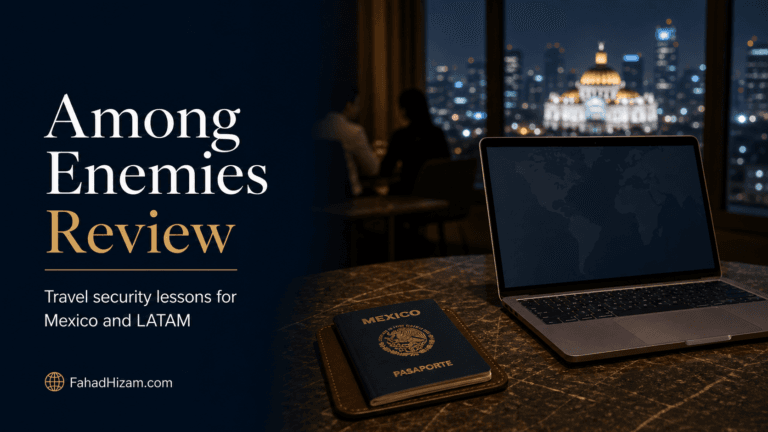

I once watched a business traveler take a client call in a hotel restaurant with his laptop open, passport beside the keyboard, and WhatsApp messages flashing across the screen.
No one had to hack him. He was giving away pieces of the case in public.
I had this kind of risk in mind when I read Luke Bencie’s Among Enemies: Counter-Espionage for the Business Traveler. I read it as a fraud and risk consultant working in Mexico and Latin America, where business travel often mixes formal meetings with informal access. The book was published in 2013, so its date matters. The best parts still hit because they deal with behavior.
Bencie writes for travelers who carry information other people may want. Executives are the obvious audience. In my work, the same risk applies to lawyers, consultants, foreign buyers, supplier-audit teams, clinic administrators, investigators, and compliance staff moving through Mexico and LATAM with client files, payment details, or access to internal systems.
The book is strongest when Bencie stays close to ordinary travel conduct. He pays attention to airports, taxis, hotels, meetings, social contact, and devices. Those details matter because most exposure does not start with a dramatic act. It starts when someone talks too much, carries too much, trusts the wrong space, or forgets that travel routines are visible.
The tactic that stayed with me is his advice on using a sanitized laptop. The travel computer should carry only what the trip requires. A 2013 ASIS Security Management review notes Bencie’s recommendation that the laptop contain the operating system, office software, and information that would cause little harm if lost. The same review also points to his advice on encrypted storage and disposable phones for higher-risk trips.
The discipline behind that advice still holds.
A traveler should not carry a full work life across borders on one device. Today, exposure often sits in cloud access, saved passwords, mobile banking, authentication apps, WhatsApp groups, and shared drives. The risk moved from files to access.
This is also where I disagree with the book’s older framing. Bencie’s world is heavily shaped by classic espionage thinking. The classic espionage frame has value, but it can make the reader look for a spy and miss the local business risk sitting closer to the table.
In Mexico and Latin America, the person who creates the problem may look ordinary. A driver can hear names, routes, and meeting times while a hotel employee notices who visits a room. A vendor may understand the payment process from inside the relationship, and a local contact can use friendly questions to build a profile of the traveler, the company, and the project. Local access can matter as much as formal intelligence collection.
I have seen investigations begin with those small openings. Someone shares a schedule too widely, discusses payment instructions too openly, plans a supplier visit through too many informal channels, or exposes a phone number to the wrong group. None of that feels serious at the time. Later, it explains how someone knew where to push.
The privacy-confidentiality distinction matters for this reason. I explain that line in my note on privacy vs confidentiality. Personal privacy protects the traveler. Confidentiality protects the client, company, case, or institution. A traveler can protect personal privacy and still expose confidential work.
For me, the best use of Bencie’s book is pre-travel conduct. Before a trip, the traveler should reduce device exposure and keep sensitive conversations out of public spaces. The same logic appears in how private investigation works in Mexico.
The 2013 date causes a practical problem now. The book cannot guide a reader through AI voice cloning, fake profiles, SIM-swap risk, biometric data, cloud account exposure, or mobile device tracking. The gap matters in LATAM because a phone often controls banking, maps, rides, messaging, identity checks, and emergency contact. A traveler using this book today should also read current guidance on SIM swapping and basic account security.
The regional gap matters too.
A Mexico City conference, a supplier visit in Bajío, a mining-related trip in northern Mexico, and a legal meeting in Central America do not carry the same exposure. Sector, route, local contacts, and applicable law all change the exposure. For cross-border clients, I cover some of those limits in my guide on private investigators in Mexico for U.S. clients.
Give Among Enemies to anyone responsible for sending staff abroad with client data, payment access, or sensitive meeting plans. It is a good behavior reset before travel. It is not a complete cyber-travel guide for 2026.
In Mexico and LATAM, treat travel details as sensitive when they reveal clients, cases, money, routes, or relationships.
You can find Among Enemies: Counter-Espionage for the Business Traveler here.
Last updated: May 10, 2026

Private investigator and criminal-justice researcher based between Mexico City and Oaxaca. He works on financial crime, due diligence, and asset tracing, and writes on policing, organized crime, corrections, and the law in three languages. More about Fahad →
Get the next essay by email.
One email each time I publish a new essay. Unsubscribe anytime.
SubscribeDiscover more from Fahad Hizam alHarbi
Subscribe to get the latest posts sent to your email.